

Suvremena trgovina interview – Ana Pašiček, Executive Director of the Global Compact Network Croatia
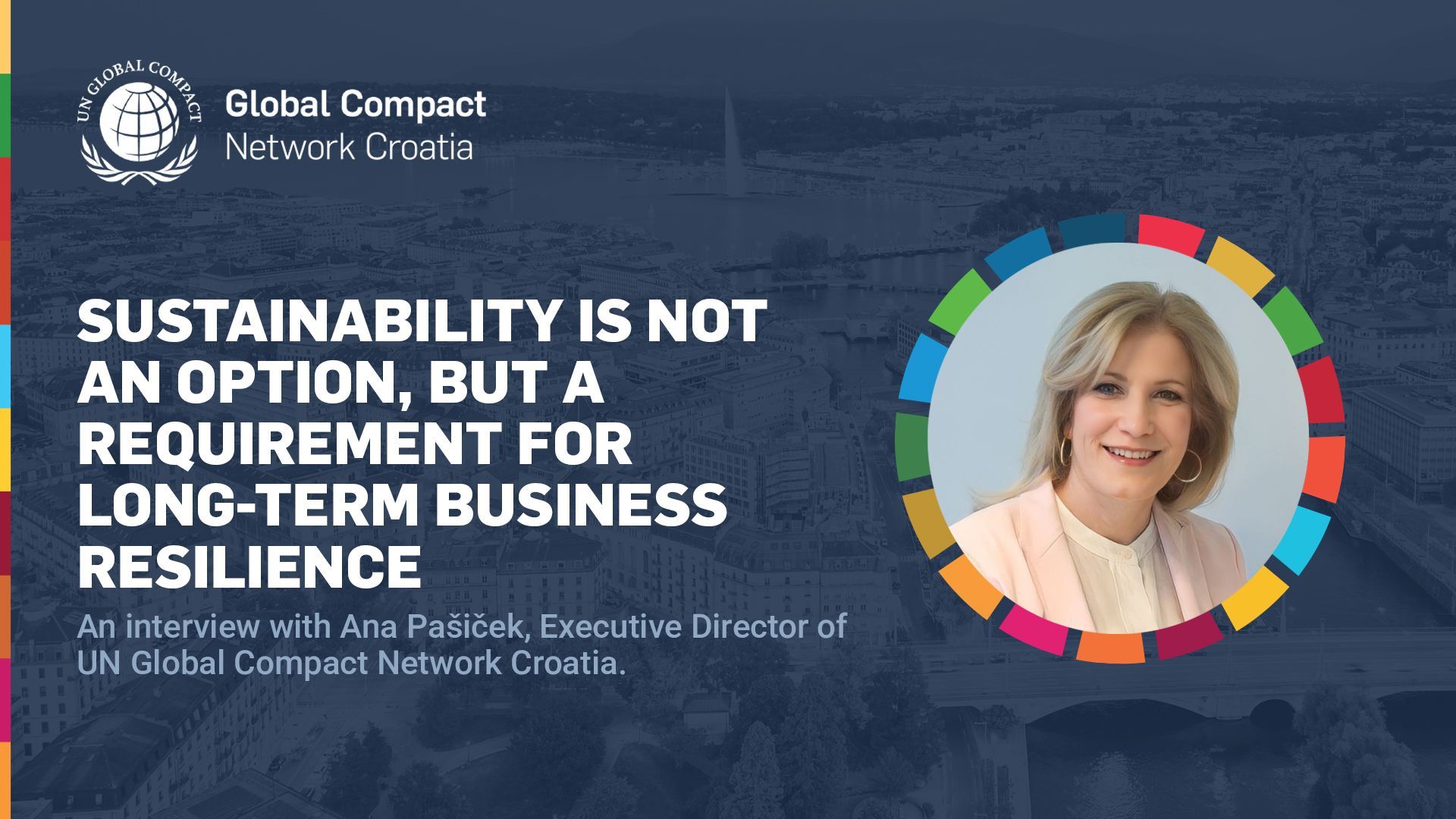
The latest issue of Suvremena trgovina magazine features an interview with Ana Pašiček, Executive Director of the Global Compact Network Croatia, on the role of sustainability in today’s business environment, the evolving ESG regulatory framework, and the challenges faced by companies in Croatia.
We are sharing the full interview below.
Sustainability as a Tool for Long-Term Business
In a time of accelerating climate change, volatile markets and increasingly demanding regulation, sustainability is becoming less a matter of reputation and more a matter of resilience and competitiveness.
For years, the Global Compact Network Croatia has brought together companies committed to responsible business practices aligned with international standards on human rights, environmental protection and anti-corruption. To understand where Croatian companies truly stand today, where they face the greatest challenges and how global goals can be translated into a local context, we spoke with Ana Pašiček, Executive Director of the Global Compact Network Croatia.
ST: The Global Compact Network Croatia has long encouraged sustainable and ethical business practices among domestic companies. In the context of accelerating climate change and economic turbulence, how do you see the actual implementation of these principles among Croatian companies today?
Pašiček: In practice, we see very different levels of maturity and approaches among Croatian companies. Some view sustainability strategically as something that directly affects their resilience and their relationships with employees, suppliers and investors. In those cases, the changes are real and long-term.
On the other hand, some companies are still in the phase of meeting minimum requirements, often driven primarily by regulatory pressure. In the context of climate change and economic instability, it is becoming increasingly clear that sustainability is not a luxury it is a tool for risk management and long-term business stability.
ST: The Ten Principles of the UN Global Compact cover human rights, labour, the environment and anti-corruption. Where do Croatian companies most often lag behind in implementing them, and why?
Pašiček: Today, the most common challenges relate to climate change particularly in assessing climate risks, adapting business operations and strengthening long-term resilience. Many companies have taken initial steps toward reducing emissions, but it is much more difficult to address questions such as how climate risks affect their operations, supply chains or financial stability, and how to prepare for them systematically.
Alongside climate issues, significant challenges remain in the area of human rights in supply chains.
While internal policies are often relatively well established, monitoring and managing impacts among suppliers is considerably more complex, especially for companies with international or complex procurement chains.
In both cases, the main issue is usually not a lack of intention, but a lack of knowledge, experience and practical tools. This is where we see the role of the Network to help companies understand what international standards and new regulations expect from them, and how to translate those expectations into concrete, practical steps in a real business environment.
ST: Participation in the Network requires commitment and resources. How do you measure the concrete impact of your Network on the business performance and competitiveness of members, beyond reputation?
Pašiček: We primarily track impact through the Communication on Progress (COP) report, which all members are required to submit annually. It provides a clear and comparable framework for monitoring progress over time in the areas of human rights, labour, the environment and anti-corruption.
For many companies especially those not subject to regulatory reporting the COP is often the only structured framework for sustainability reporting. That is precisely why it has such value: it encourages companies to systematically reflect on their policies, practices and impacts for the first time, and to monitor and improve them regularly.
At the Network level, COP data allows us to identify broader trends, areas where members most frequently make progress, and areas where additional activities, education or support may be needed. In this way, the Network serves not only as a platform for dialogue, but also as a mechanism that encourages improvements in responsible and sustainable business practices.
ST: To what extent is Croatian regulation supportive or perhaps an obstacle for companies that want to integrate sustainability into their strategy and practices?
Pašiček: I would say that regulation is a necessary framework that provides direction, but on its own it is not enough. EU regulation clearly sets expectations, but the speed of change often creates uncertainty for companies.
That is why it is important that regulation is accompanied by clear guidance, education and space for dialogue. Otherwise, there is a risk that sustainability will be reduced to a purely administrative exercise.
ST: Global trends such as ESG reporting standards and sustainable finance are increasingly shaping investor and market expectations. How does your Network help companies prepare for these requirements?
Pašiček: Our focus is on practicality. We help our members understand what is expected of them and how to connect those requirements with their own business models.
Through education, workshops and accelerator programmes, we work to ensure that ESG does not remain an abstract concept but becomes a tool for better decision-making. The exchange of experiences among members is particularly important, because companies often learn best from one another.
ST: Inclusion and equality are also increasingly discussed as part of sustainable business. How do you address these topics through programmes or initiatives, and what results are you seeing?
Pašiček: These topics are currently in the phase of preparation and structuring. We see growing interest among companies, primarily due to upcoming regulatory requirements such as pay transparency, but also because of market expectations.
That is why we are using this year to develop targeted programmes and formats that will address these issues in a practical and meaningful way.
Our goal is to provide companies with tools, knowledge and learning opportunities in time, so they can approach these issues systematically and proactivelyrather than only when they become legal obligations.
ST: Many citizens and small entrepreneurs are not familiar with concepts such as ESG or SDGs. How does the Network work to make sustainability more understandable and relevant to the broader business community and society?
Pašiček: When approaching sustainability, we do not start with terminology we start with real business challenges.
For most people, ESG or SDGs (Sustainable Development Goals) mean very little until they are connected with concrete issues they face in their daily operations. That is why we explain sustainability through practical topics: energy costs, working conditions, employee relations, supply security, access to finance or customer requirements.
Once companies understand that sustainability relates directly to their competitiveness, stability and long-term survival, the terminology becomes less important. Our role is to translate global concepts into the language of everyday business and demonstrate that sustainability is not an add-on it is an integral part of business itself.
ST: How do you see the role of the Global Compact Network in connecting the private and public sectors, particularly in partnerships for implementing sustainable policies and practices in Croatia?
Pašiček: For us, the public sector is an important partner in the context of sustainable development, particularly when it comes to understanding and implementing public policies that affect businesses.
The Sustainable Development Goals require cooperation among different stakeholders, and the Network serves as a platform for dialogue. Through collaboration with public institutions and bodies - primarily through information exchange and discussions on regulatory frameworks - we aim to bring the objectives of public policy closer to the real conditions in which companies operate.
This helps improve mutual understanding of expectations and challenges, which is often the first step toward more effective implementation in practice.
ST: Agenda 2030 and the SDGs represent ambitious global standards, but many consider them abstract in local contexts. What does the Network do to make these goals achievable in Croatia?
Pašiček: Our approach is highly practical. We do not start with all 17 goals at once. Instead, we work with companies to identify where they have real impact and responsibility within the Croatian context.
This means linking SDGs with concrete topics such as employment, working conditions, energy efficiency, equality, supply chain resilience or local development.
Through our programmes, we help members translate global goals into specific policies, objectives and measurable actions that are applicable in their everyday business operations in Croatia. Rather than focusing on abstract targets, the emphasis is on practical questions: what are we doing differently, how do we measure progress and how does this fit into our strategy and local context?
ST: Could you explain the role and significance of the accelerator programmes currently underway?
Pašiček: Accelerators are programmes in which companies do not simply listen to lectures they work on their own challenges with a clear structure and guidance.
Currently we are running two key programmes. The Business & Human Rights Accelerator helps companies systematically assess human rights risks within their operations and supply chains. Through the programme, companies identify and prioritise specific human rights risks and develop an action plan focused on a selected vulnerable group, in line with the UN Guiding Principles on Business and Human Rights.
The SDG Innovation Accelerator brings together young professionals from companies and supports them in developing innovative solutions or initiatives linked to the Sustainable Development Goals. Participants work through practical projects, mentorship and collaboration, focusing on solutions that create real value for their companies.
What both programmes have in common is that participants leave with concrete solutions and clear next steps that can be applied directly in their business operations.
ST: If a company is considering sustainability but is unsure where to start, why should it join the Global Compact Network Croatia?
Pašiček: Joining the Global Compact Network Croatia provides companies with a framework, support and a community.
We do not offer ready-made solutions for everything; rather, we help companies identify what is relevant and feasible for them. Membership means access to knowledge, tools and programmes, but also the opportunity to exchange experiences with other companies facing similar challenges.
For many companies especially those not yet subject to regulatory reporting membership and reporting on progress often represent the first structured step toward sustainable business.
Ultimately, our goal is to help companies make sustainability part of their strategy and everyday decisions—not something they do only because they have to.
The latest issue of Suvremena trgovina is available
here
(HR).
Blog EN